

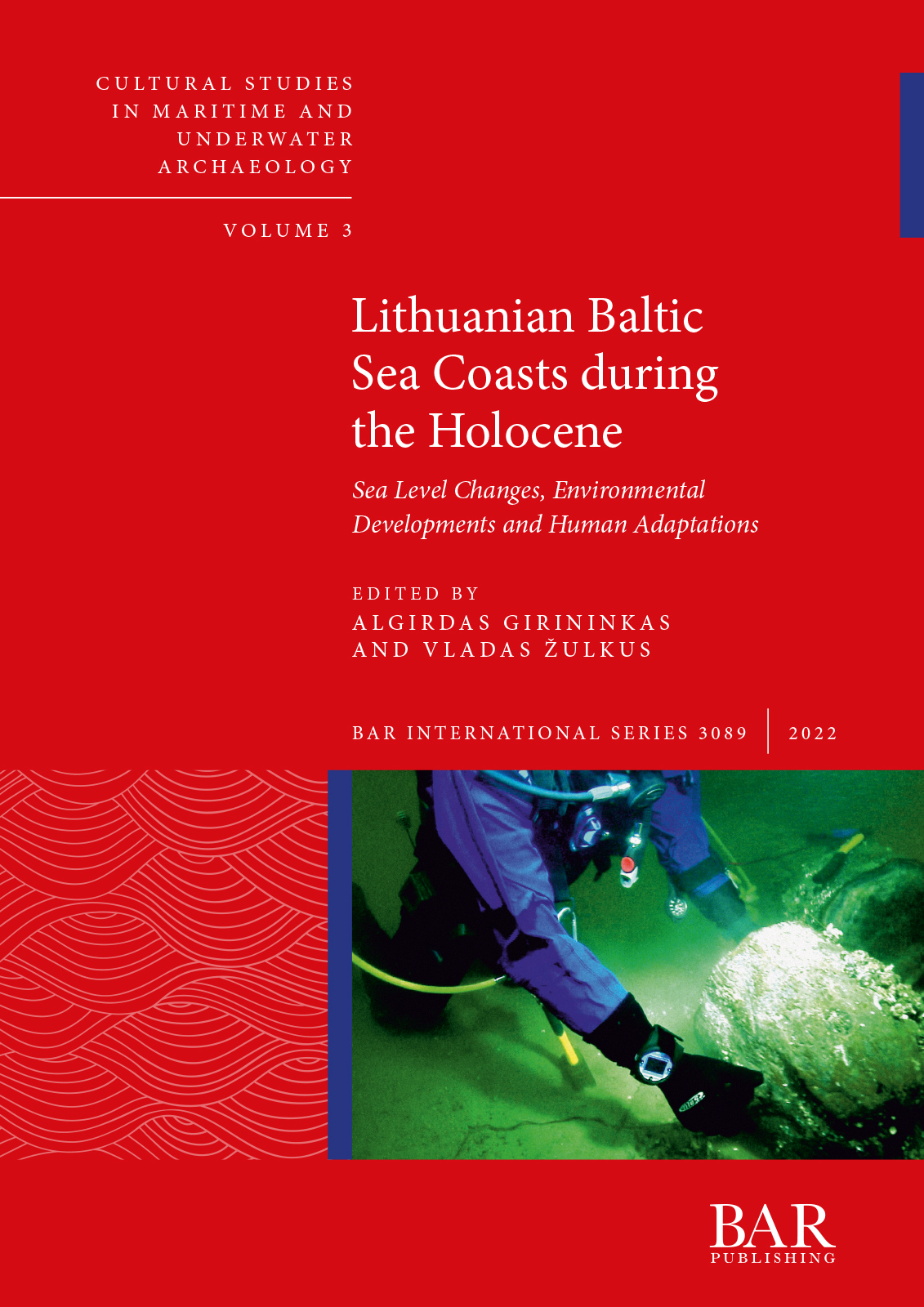
31/07/2022English168S3089BAR International Series
Lithuanian Baltic Sea Coasts during the Holocene
Sea Level Changes, Environmental Developments and Human Adaptations
Edited by Algirdas Girininkas and Vladas Žulkus
£39.00 – £50.00
Select format
In Print
Description
Lithuanian Baltic Sea Coasts During the Holocene focuses on the relicts of the cultural and natural landscapes that survived in the Baltic Sea during the final Paleolithic-Middle Neolithic period in Lithuania. Using a combination of interdisciplinary research methodologies from archaeology, physical and biomedical sciences, with innovative use of underwater technologies, the contributors identify complex underwater landscapes (relic forests, peat bogs, lagoons, paleodelts or palaeo-riverbeds) and cultural objects to determine the evolution of marine paleobasin formation, sea level fluctuations and climate change.
About the Editor
Algirdas Girininkas is Professor of archaeology at the University of Klaipeda, Lithuania. His research interests include material and spiritual culture of the Stone and Bronze Age, economic and social development, and ethnocultural contexts in the Eastern Baltic region. He has published more than ten books on the subject. Vladas Žulkus is Research Fellow and Professor of archaeology at the University of Klaipeda, Lithuania. He has led underwater archaeological research, including to the flooded landscapes at Baltic Sea. His current research involves the landscape evolution and sea-level changes during the Holocene. He is the author of several papers on the subject. Contributors: Albertas Bitinas, Jurata Buchovska, Aldona Damušyte, Darius Danusevicius, Linas Daugnora, Nikita Dobrotin, Jolita Petkuviene, Tomas Rimkus, Migle Stancikaite, Sergej Suzdalev, Giedre VaikutieneReviews
'The articles not only report the current state of research in their specific fields, but do so against the background of their new research data. These are based on the most modern, partly innovative methods. The reader is led to the front line of research.' Dr Ulrich Schmölcke, Centre for Baltic and Scandinavian Archaeology (ZBSA) 'The work - both the data and the interdisciplinary approach - is highly original. Much of the data is completely new, especially from underwater contexts. The methods used are cutting edge.' Dr Aki Hakonen, University of OuluYou might also like...
-
The Outcast Dead
Brittney K. Shields WilfordPrint Book £29.00
PDF eBook £23.00 -
The Neolithic-Bronze Age Transition in Britain
Neil BrodiePrint Book £30.00
PDF eBook £23.00 -
Waffen in germanischen Gräbern der älteren römischen Kaiserzeit südlich der Ostsee
Timm WeskiPrint Book £84.00
PDF eBook £65.00 -
Zooarchaeology of the Pleistocene/Holocene Boundary
Jonathan C. DriverPrint Book £23.00
PDF eBook £19.00 -
The Paiján People
Jean-Paul Lacombe and Claude ChauchatPrint Book £35.00
PDF eBook £27.00

