

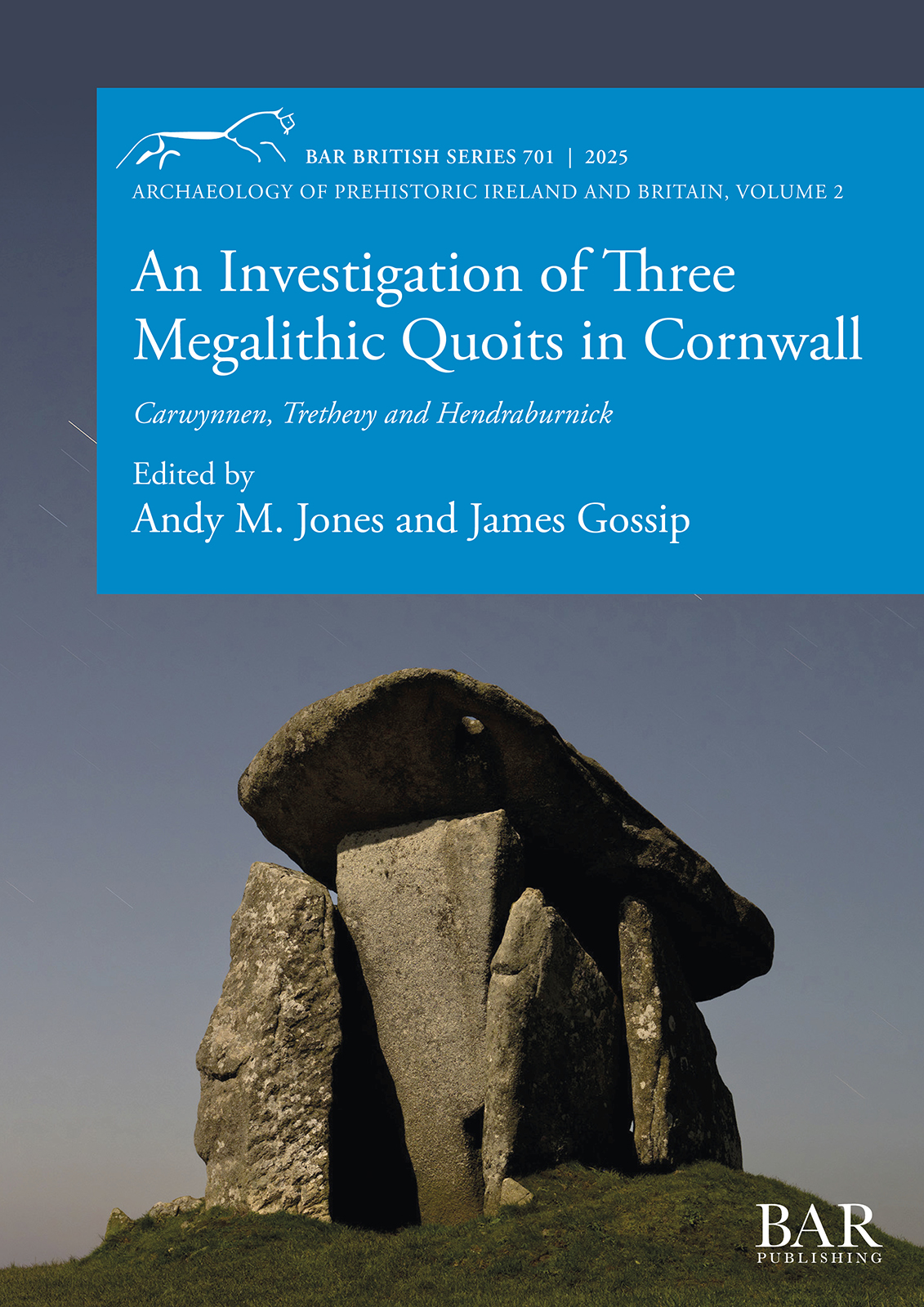
An Investigation of Three Megalithic Quoits in Cornwall
Carwynnen, Trethevy and Hendraburnick
Edited by Andy M. Jones and James Gossip
$46.20 – $63.00
Description
This monograph reports upon the recent excavations of three Cornish megalithic monuments, known locally by the suffix as quoits, which were undertaken by Cornwall Archaeological Unit, with support from the Cornwall Archaeological Society, The Cornwall Heritage Trust and The Sustainable Trust. Two of the sites, Carwynnen and Trethevy, are Early Neolithic chamber tombs and the third, Hendraburnick, is a later Neolithic megalithic propped stone. All three sites are complex monuments and two, Carwynnen and Hendraburnick, revealed episodes of re-use for centuries after their construction. All three sites demonstrate the careful selection of materials in their construction, demonstrating the desire to use particular shapes and colours. There is evidence at all three sites for the selection of specific stones, and for a variety of depositional practices at Carwynnen Quoit and Hendraburnick Quoit, which went beyond the interment of human remains. At Hendraburnick these practices included the incorporation of rock art.
About the Editor
Andy M. Jones’ research interests included the Neolithic and Bronze Age periods. Major projects included the publication of the Whitehorse Hill cist and the Bronze Age coastal change at Mounts Bay.
James Gossip has considerable post-excavation and publication experience. He is an experienced field surveyor and has directed and published a number of major excavations including Tremough and Boden.
List of Contributors: Colin Bristow, Dana Challinor, James Gossip, Andy M. Jones, Anna Lawson-Jones, Jacqueline A. Nowakowski, Henrietta Quinnell, Pip Richards, Alison Sheridan
Reviews
‘Presenting these three excavations is a major advance in our understanding of Neolithic megalithic monuments in Cornwall, and represents a very significant contribution.’
Dr Susan Greaney, University of Exeter
You might also like...
-
Pre and Protohistoric Archaeology of Chunar, Mirzapur (Uttar Pradesh)
New research from Dantari HillWritten by Virag G. Sontakke,Sachin Kr. Tiwary andDheeraj SharmaPrint Book $42.00
PDF eBook $30.80 -
Tree-Ring Studies of Wood Used in Neolithic and Bronze Age Trackways from the Somerset Levels, Parts i and ii
Written by Ruth A. MorganMulti-volume Print Books Original price was: $150.00.$150.00Current price is: $150.00.
PDF eBook $98.00 -
Zooarchaeology in the Middle Nile Valley
A Study of four Neolithic Sites near KhartoumWritten by Ali Tigani ElMahiPrint Book $65.00
PDF eBook $43.40 -
ʻEn Esur (ʻEin Asawir) IV, the 2017–2019 Excavations
Introductions, overview of the finds and the Early Bronze Age IA villageWritten by Itai Elad, Yitzhak Paz and Dina ShalemPrint Book $138.00
PDF eBook $99.40 -

Use-wear Analyses of Polished and Bevelled Stone Artefacts during the Sepulcres de Fossa/ Pit Burials Horizon (NE Iberia, c. 4000–3400 cal B.C.)
Written by Alba Masclans LatorrePrint Book $99.00
PDF eBook $64.40

