

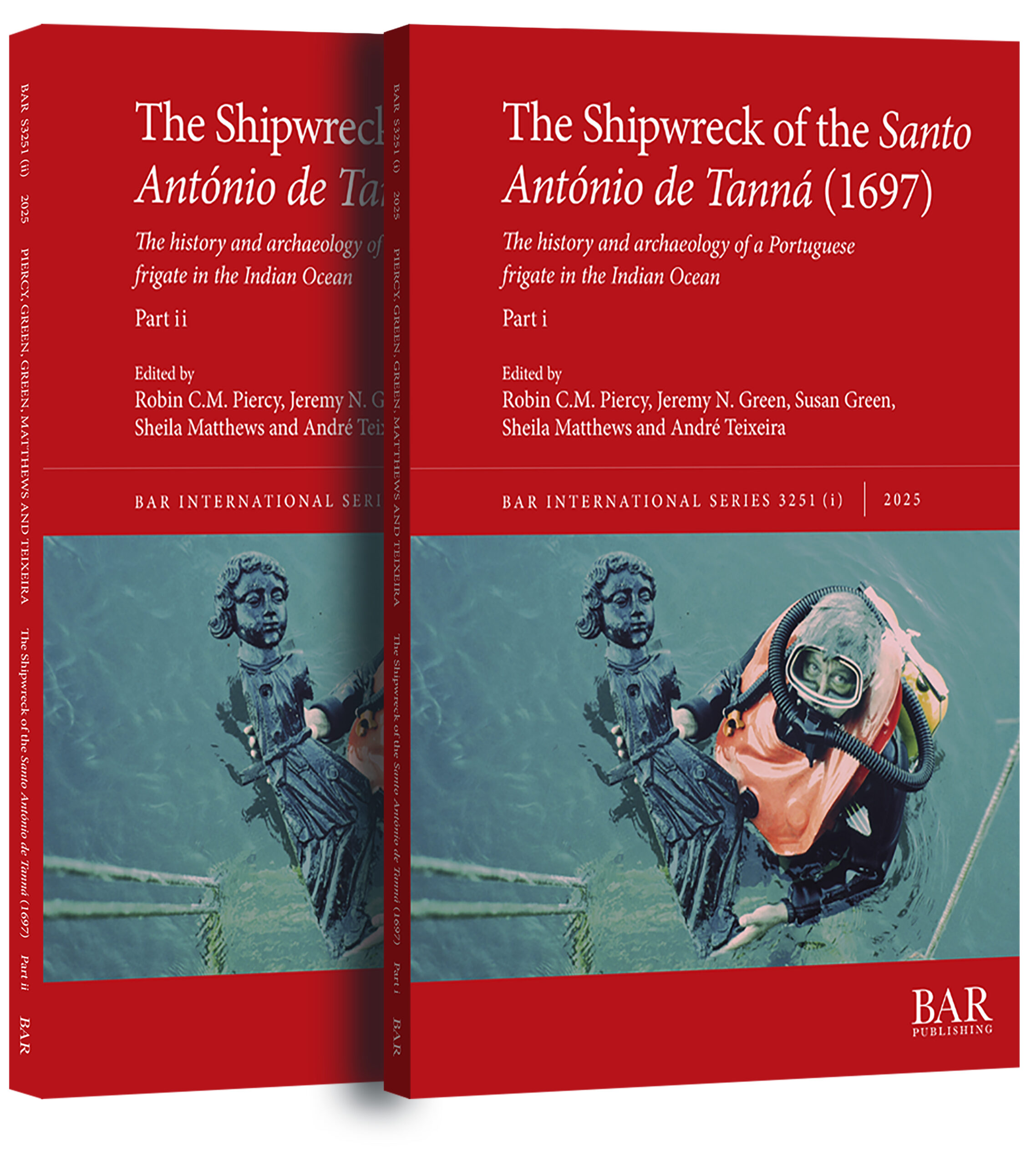
The Shipwreck of the Santo António de Tanná (1697), Parts i and ii
The history and archaeology of a Portuguese frigate in the Indian Ocean
Edited by Robin C.M. Piercy, Jeremy N. Green, Susan Green, Sheila Matthews and André Teixeira
£177.00 – £230.00
Description
The shipwreck of the Portuguese frigate Santo António de Tanná, sunk in Mombasa in 1697, occurred during an Omani attack on the city, which was at that time controlled by the Portuguese. It was excavated in the 1970s, by a joint team of the Institute of Nautical Archaeology (INA) and the National Museums of Kenya.
During the excavations, a significant part of the ship’s hull and more than 7,000 objects related to its operation, life on board and commercial activity were identified. All this information is presented and analysed in this book, together with the written sources which relate to the ship. This archaeological site now belongs to an area classified as a world heritage site, and reveals a unique convergence of Asian, African and European people at the dawn of globalization.
This book is part of a two-part set: ISBN 9781407364179 (Part i); ISBN 9781407364186 (Part ii); ISBN 9781407362656 (set of both parts).
About the Editor
Robin C.M. Piercy has been involved in underwater archaeology since 1966, and directed the 1977–1980 Institute of Nautical Archaeology (INA) and National Museums of Kenya excavations of the Santo António de Tanná. He is now based in Turkey, where he has led numerous other INA excavations and has helped to design and operate a wood conservation facility in Bodrum.
Jeremy N. Green was the Head of the Department of Maritime Archaeology at the Western Australian Museum from 1971 until he retired in July 2021. In 1978 he established the Australian Institute for Maritime Archaeology, and currently holds numerous positions including membership of the Council for Nautical Archaeology, Honorary Research Fellow in the School of Social Sciences at the University of Western Australia, and Adjunct Associate Professor at Curtin University.
Susan Green was senior editor of Paradigm Books Curtin University from 1991 to 1999, when she formed her own firm, Chipped Quill Publishing Services. She edited academic books and journals covering a wide range of disciplines. She assisted many of the Western Australian Museum staff in publications, and worked on Museum excavations in Australia, Kenya, Thailand and Sri Lanka. She has worked as the substantive editor of this publication since 2010.
Sheila Matthews has been involved in underwater archaeology as part of the INA since 1978, and in 2000 became the Institute’s mapping expert. She now serves as a Director at the INA, assisting with outreach projects.
André Teixeira is an Associate Professor at NOVA School of Social Sciences and Humanities (Lisbon, Portugal). He is also a researcher at CHAM–Centre for Humanities. His research includes the study of Portuguese overseas expansion, medieval and early modern military architecture, and colonial Portuguese material culture.
List of Contributors: Daniel Adams, João Gonçalves Araújo, Joana Baço, José Bettencourt, Jean-Yves Blot, Maria Luisa Pinheiro Blot, Patrícia Carvalho, Christelle Chouzenoux, Inês Pinto Coelho, Teresa Ramos Costa, Tiago Curado, Alison Christine Darroch, Randel C. Davis, Jill Dias, Sara Ferreira, Tiago Miguel Fraga, Jorge Freire, Donald A. Frey, Ana Catarina Garcia, Luís Serrão Gil, Jeremy N. Green, Susan Green, Jerome Hall, James Kirkman, Gonçalo C. Lopes, Ariane Maggio, Sheila Matthews, Thomas J. Oertling, Robin C.M. Piercy, Marco Pinto, Christine A. Powell, Mónica Esteves Reis, Hamo Sassoon, Lisa Shuey, Tiago Silva, André Teixeira, Andreia Martins Torres, Joana Bento Torres, Bruce F.C. Thompson, Farid Paul Willoughby, Andrew Woods.
Reviews
‘This book is of great interest for any researcher of the archaeology of Iberian colonies in the 17th century.’ Dr Ricardo Borrero L., Texas A&M and Colombian Institute of Anthropology and History
‘[F]inally having all material published is of major importance, as the wreck is a unique view of a Portuguese warship at the end of the 17th century.’ Professor Augusto Salgado, Lisbon University
‘The extensive artifacts excavated from the wreck and studied in this publication will shed light on the complex interactions between African, Indian, Portuguese, and Omani cultures; there is evidence that the crew of the Santo António was multi-cultural. It is my hope that with the publication of this book, others may be interested in continuing the study of this amazing wreck and the stories it can tell the world.’ Brian Jordan, U.S. Department of the Interior, Bureau of Ocean Energy Management
You might also like...
-
The Mortella III Wreck: a Spotlight on Mediterranean Shipbuilding of the 16th Century
Written by Arnaud Cazenave de la RochePrint Book £73.00
PDF eBook £52.00 -
Proceedings of the Second International Conference on Aviation Archaeology and Heritage – November 2024
Edited by Hunter W. Whitehead, Natasha J. Heap, Daniel J. LeahyPrint Book £34.00
PDF eBook £26.00 -
The Final Analysis of Weights from Port Royal, Jamaica
Written by C. Wayne SmithPrint Book £54.00
PDF eBook £39.00 -
The Stirling Castle, a 70-gun Ship Lost in the Great Storm of 1703: Archaeological Investigations 1979-2009
Edited by Julian WhitewrightPrint Book £79.00
PDF eBook £55.00 -
The Zeebrugge Shipwreck
A forgotten early sixteenth-century merchantman discovered off the Belgian coastWritten by Hendrik LettanyPrint Book £37.00
PDF eBook £26.00

