

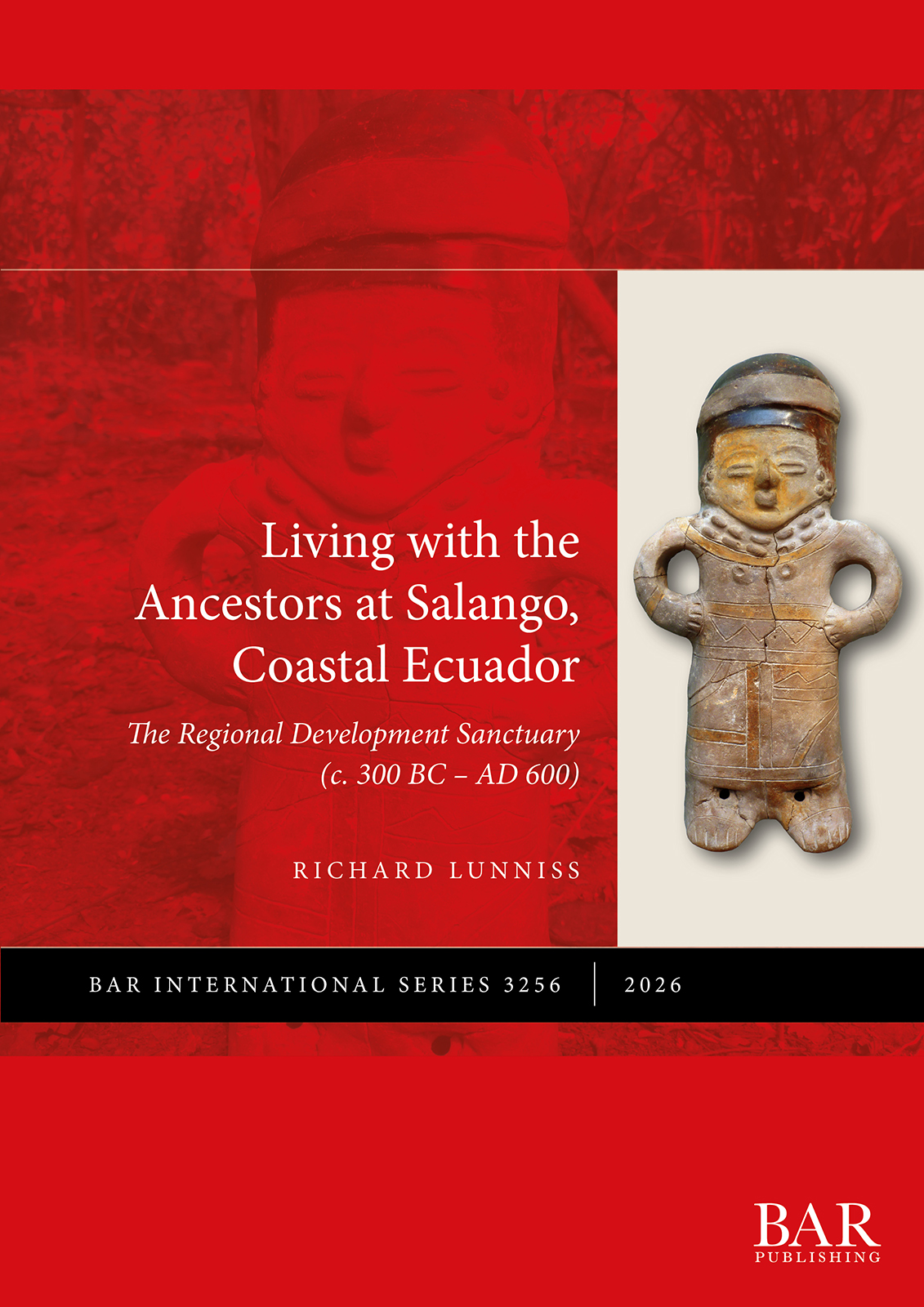
Living with the Ancestors at Salango, Coastal Ecuador
The Regional Development Sanctuary (c. 300 BC – AD 600)
Written by Richard Lunniss
$71.40 – $99.00
Description
Following on from the previous publications Cultural Identity, Transition, and Interaction at Salango, Coastal Ecuador (BAR S3109, 2022) and The Sequence of Late Formative Ceremonial Structures at Salango, Coastal Ecuador (BAR S3117, 2023), this book presents the first full account of Salango’s unparalleled Regional Development sanctuary. Drawing on the results of extensive stratigraphic excavations initiated in 1982, it describes in detail the changing design and architectural components of the sanctuary and its varied human burials, ritual installations, and offerings through three cultural phases and eleven main construction episodes spanning 300 BC to AD 600. With abundant photographs of the excavations and the rich assemblage of pottery vessels and other artefacts recovered, mostly in colour, the archaeological data are woven into a narrative history of ancestors, place, and ritual that reflects events and processes operating across coastal Ecuador and beyond.
About the Author
Richard Lunniss is a Research Professor at the Universidad Técnica de Manabí, Portoviejo. His work focuses on the Pre-Columbian history of the central Ecuadorian coast.
Reviews
‘This book will be a major contribution to the prehistory of the northern Andes. The author’s interpretations of the site’s history and its relationship to volcanic eruptions is original, as is his argument concerning the relationship of the burials to the perceived sacred power of the original temple and the ancestors buried there.’ Professor Richard Burger, Yale University
‘This publication represents years of research and dedication by the author to this unique and important archaeological site. No site to equal Salango has ever been discovered in coastal Ecuador.’ Professor Maria Masucci, Drew University
You might also like...
-
The Sequence of Late Formative Ceremonial Structures at Salango, Coastal Ecuador
Richard LunnissPrint Book $49.50
PDF eBook $35.00 -
Fragile Gods
Matthew FittockPrint Book $123.00
PDF eBook $88.20 -
The Festival Cycle of the Aztec Codex Borbonicus
N.C. Christopher CouchPrint Book $66.15
PDF eBook $54.60 -
The Life Biography of Artefacts and Ritual Practice
Mathias Bjørnevad-Ahlqvist and Peter Bye-JensenPrint Book $55.35
PDF eBook $44.80 -
Theatres of Imagery
David M. WitelsonPrint Book $91.50
PDF eBook $65.80

