

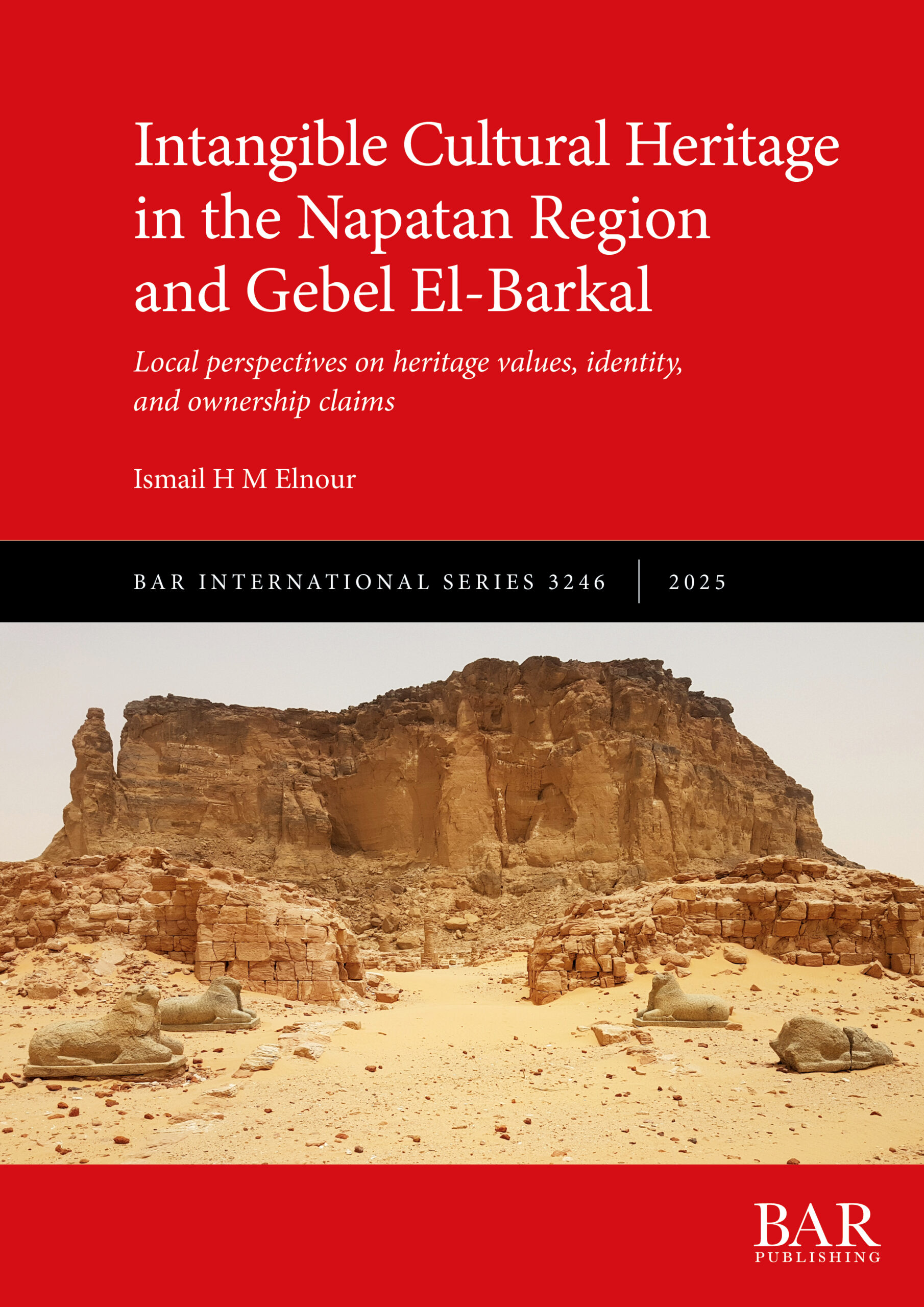
Intangible Cultural Heritage in the Napatan Region and Gebel El-Barkal
Local perspectives on heritage values, identity, and ownership claims
Written by Ismail H M Elnour
$44.80 – $73.50
Description
This study challenges conventional approaches to heritage management by examining the complex relationship between local communities and the UNESCO World Heritage Site of Gebel El-Barkal in Sudan. Moving beyond the elite-driven “Authorized Heritage Discourse,” the author employs ethnographic and phenomenological methods to center local voices and their intangible cultural heritage.
The research reveals how archaeological sites exist simultaneously as global monuments, national symbols, and living spaces imbued with everyday cultural meaning. By adopting a bottom-up approach, the study illuminates how local communities conceptualize these ancient places through their own knowledge systems, values, and identity claims—often in tension with official narratives. This nuanced exploration considers how factors including ethnicity, religion, social class, gender, and age position different community members in relation to heritage sites. The findings offer valuable insights for scholars, policymakers, and heritage professionals seeking more inclusive and sustainable approaches to cultural heritage management that honour local perspectives alongside global significance.
About the Author
Ismail H M Elnour is a UNESCO cultural heritage expert specializing in community engagement and heritage interpretation at World Heritage Sites, with published research on heritage studies.
Reviews
‘The research simultaneously addresses theoretical gaps in heritage understanding and provides a practical framework for community engagement. Advocating for the recognition of intangible cultural heritage alongside archaeological sites promotes an inclusive approach to cultural heritage that not only enriches academic research, but also helps to empower local communities as key stakeholders in the conservation and interpretation of their cultural heritage.’ Dr Mohamed Bashir, University of Khartoum
You might also like...
-
Modern Quarries and Archaeology
Sara MarinoPrint Book $57.00
PDF eBook $42.00 -
Roman Rural Settlement in Wales and the Marches
Leah ReynoldsPrint Book $69.00
PDF eBook $49.00 -
Fragile Gods
Matthew FittockPrint Book $123.00
PDF eBook $88.20 -
The end of Roman Britain
P. J. CaseyPrint Book $85.05
PDF eBook $70.00 -
Projectile Points, Hunting and Identity at Neolithic Çatalhöyük, Turkey
Lilian DogiamaPrint Book $69.00
PDF eBook $49.00

