

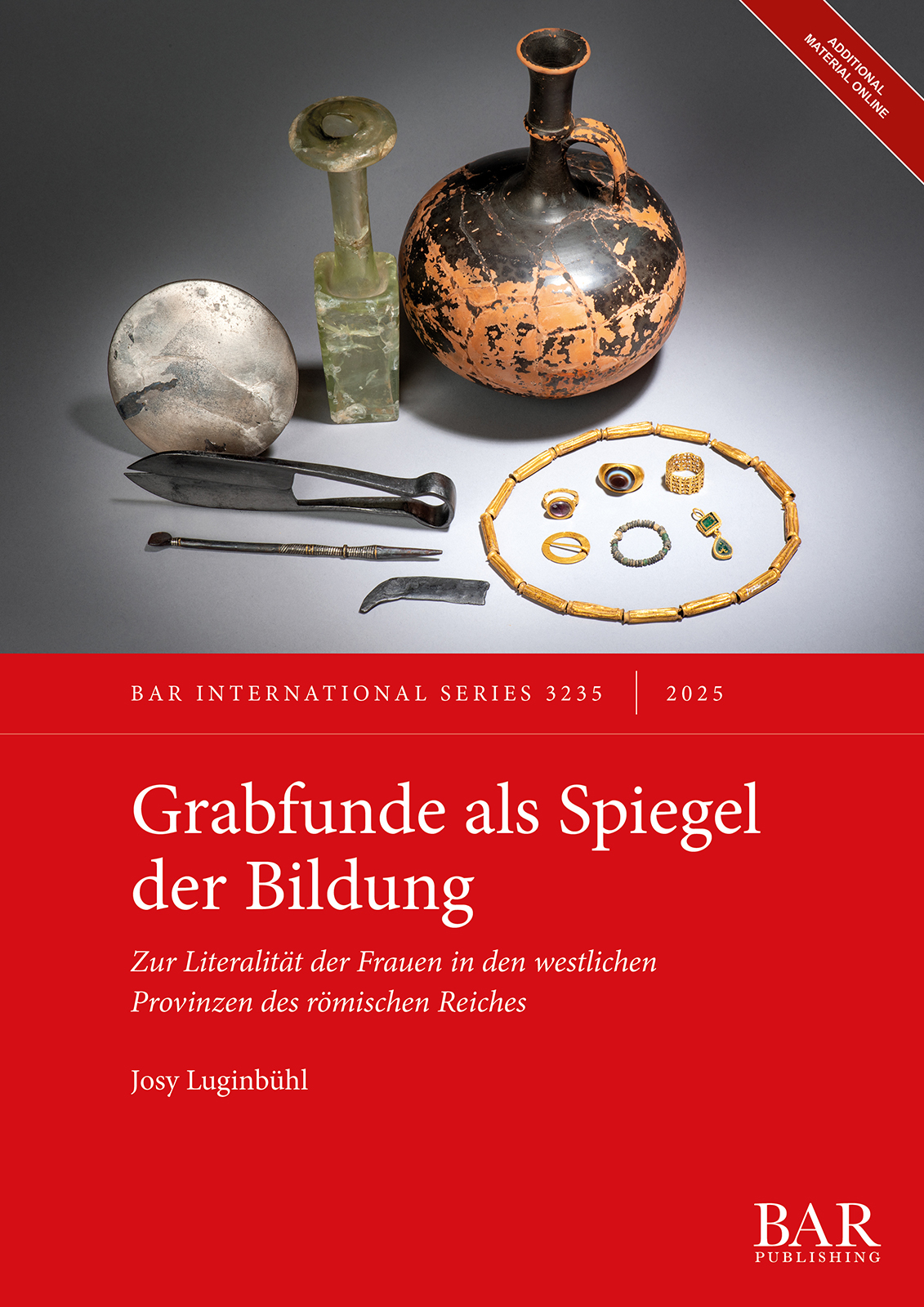
Grabfunde als Spiegel der Bildung
Zur Literalität der Frauen in den westlichen Provinzen des römischen Reiches
Written by Josy Luginbühl
€1.00 – €106.80
Description
Dies ist ein Open-Access-Titel, der unter den Bedingungen einer CC BY-NC 4.0-Lizenz verfügbar ist. Er kann kostenlos gelesen, heruntergeladen und auf der BAR Digital-Plattform geteilt werden.
Archäologische Funde aus dem Grabkontext zeigen, dass Frauen aus verschiedenen sozialen Schichten über Lese- und Schreibfähigkeiten verfügten. Durch Schreibgerätebeigaben, oberirdische Grabmarkierungen und Inschriften lassen sich so Spuren für weibliche Literalität in den gesamten römischen Westprovinzen belegen.
Besonders häufig fanden sich Schreibgeräte in Gräbern wohlhabender Frauen, was auf ihre Bildung und die Bedeutung von Schriftlichkeit hinweist. Auch Mädchen wurden schon früh in Lesen und Schreiben unterrichtet, wie Funde von Schreibtafeln in Kindergräbern belegen. Die Selbstdarstellung als gebildete Frau, oft mit Schriftrollen oder Schreibtafeln auf Grabreliefs, war ein Ausdruck von Status und kultureller Zugehörigkeit. Doch wie Inschriften zeigen, gab es auch gebildete Sklavinnen und Freigelassene. Die Untersuchung zeigt, dass gebildete Frauen im Römischen Reich keine Seltenheit waren, auch kein unerreichbares Ideal, sondern ein Teil der realen Lebenswelt.
This is an open access title available under the terms of a CC BY-NC 4.0 License. It is free to read, download and share on the BAR Digital platform.
Archaeological finds from burial contexts throughout the Roman western provinces show that women from different social classes had reading and writing skills. Traces of female literacy can be linked to writing utensils, above-ground grave markers and inscriptions.
Writing implements were found particularly frequently in the graves of wealthy women, indicating their education and the importance of literacy. Girls were also taught to read and write at an early age, as evidenced by the discovery of writing tablets in children’s graves. Presenting themselves as educated women, often with scrolls or writing tablets on tomb reliefs, was an expression of status and cultural affiliation. However, as inscriptions show, there were also literate female slaves and freedwomen. This study shows that educated women were not a rarity in the Roman Empire, nor were they an unattainable ideal but evident in all levels of society.
About the Author
Josy Luginbühl ist wissenschaftliche Mitarbeiterin an der Universität Bern. Ihre Forschung beschäftigt sich mit Römischer Archäologie, der materiellen Kultur des Alltags, Gender Studies und der Provenienzforschung.
Josy Luginbühl is a research associate at the University of Bern. Her research focuses on Roman archaeology, material culture of daily life, gender studies and provenance research.
Reviews
‘Unlike previous studies that mostly focused on the education and literacy of the male and mostly urban Roman upper class, this book focuses on archaeological, pictorial, and epigraphic evidence from burial contexts of large parts of the Roman Empire with special focus on the literacy of women. This way, the urban Roman perspective is not only significantly expanded to include the provinces, but also the literacy of women in relation to that of men is explicitly studied.’ Prof. Dr. Elena Mango, University of Bern
You might also like...
-
Military Households of Roman Auxiliary Commanders in Western Europe and North Africa
Claire MillingtonPrint Book €58.80
PDF eBook €46.80 -
Investigating Consumption: The Archaeology of Social Practice
Daniël P. van Helden and Victoria SzafaraPrint Book €66.00
PDF eBook €51.60 -

Zvejnieki (Northern Latvia) – Stone Age Cemetery
Francis Zagorskis. Translated from the Latvian by Valdis BerzinšPrint Book €48.00
PDF eBook €37.20 -
Transforming historical landscapes in the ancient empires
B. Antela-Bernárdez and T. Ñaco del HoyoPrint Book €84.00
PDF eBook €64.80 -
Frührömische Tierknochen aus der Neuen Residenz in Salzburg
Benjamin WimmerPrint Book €99.60
PDF eBook €76.80

