

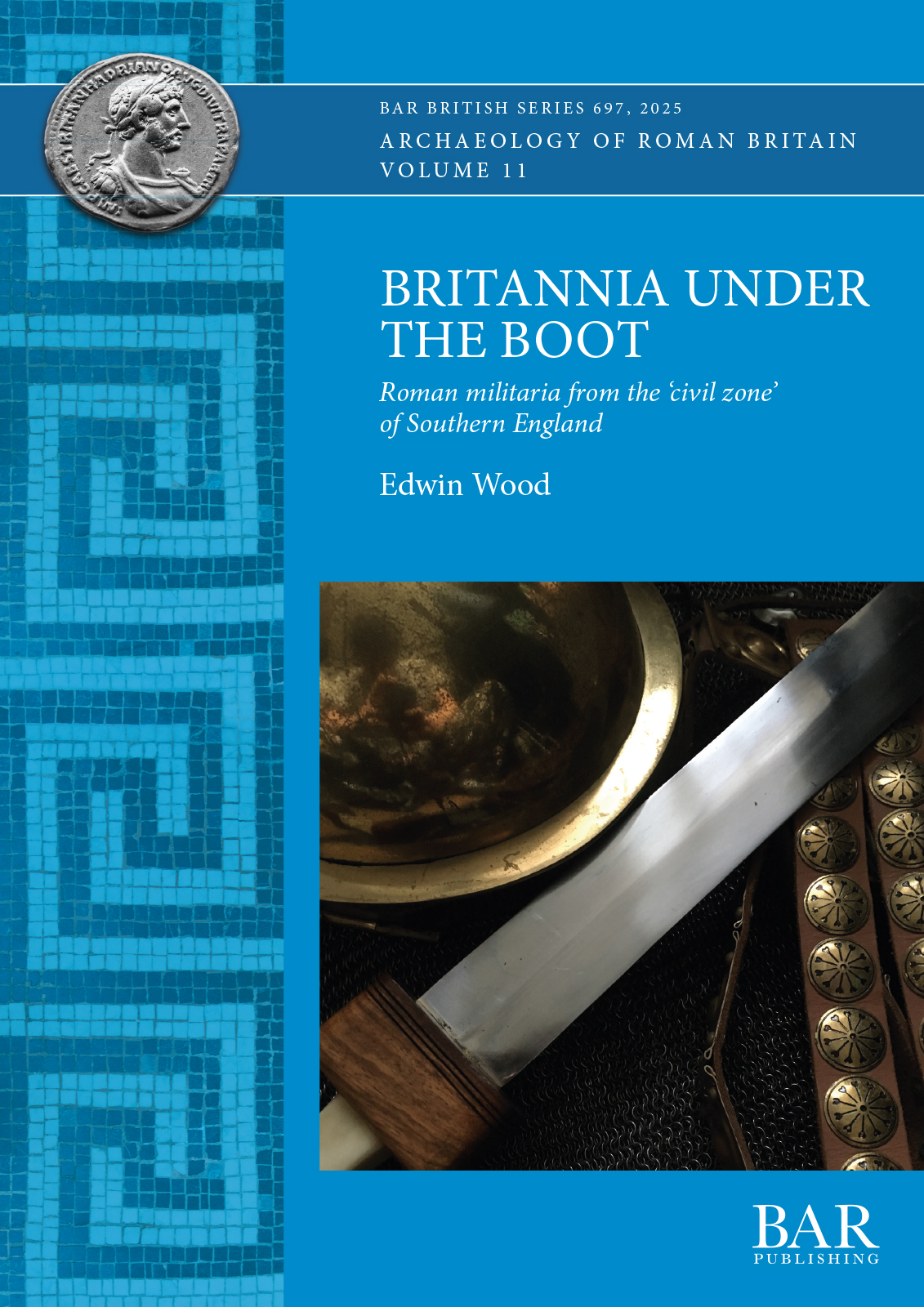
Britannia Under the Boot
Roman militaria from the 'civil zone' of Southern England
Written by Edwin Wood
£42.00 – £54.00
Description
Roman Britain is traditionally divided into a northern ‘military’ zone and a southern ‘civil’ zone with little intersection between them. This volume uses finds recovered from excavations and recorded by the Portable Antiquities Scheme from across Southern and South East England to argue that the Roman army maintained a continuous and visible presence within the ‘civil’ zone. The interaction between Rome’s occupying army and the British population is here framed in more exploitative and controlling terms. This study also critically analyses several object types, often considered military in origin. It particularly challenges the assumption that horse harness fittings can be reliably attributed to the army, instead presenting them as part of a continuous pattern of horse use with origins in the Later Iron Age. This study seeks to break down the artificial division of Britannia into military and civilian zones, preferring instead to see it all as an occupied province.
About the Author
Edwin Wood is a Roman finds specialist with a specific interest in militaria from the Roman to Medieval period.
Reviews
‘This is a really significant contribution to our understanding of the character of the Roman occupation of Britain. In detailing the evidence of the spread of military activity in the ‘civilian’ areas of Roman Britain, the author presents a compelling case that the division between this and the ‘military’ zone may not have been particularly real, and that Roman Britain was a colonial region where people lived under threat of violence. This makes a critical contribution to many wider debates about Roman imperialism in the post-colonial era.’ Professor Andrew Gardner, UCL Institute of Archaeology
‘The author very successfully challenges the split between civil and military zones with careful selection of artefact types most appropriate to identify a ‘military presence’, but also incorporates and acknowledges the nuances and unknowns that accompany such research. I particularly enjoyed the framing of militaria in ‘core’ and ‘periphery’ terms, as a way to reinforce probability to more direct military/soldier presence.’ Professor Rob Collins, Newcastle University
You might also like...
-
Romans in the Middle and Lower Danube Valley, 1st century BC–5th century AD
Eric C. De Sena and Calin TimocPrint Book £38.00
PDF eBook £30.00 -
The Defence of the Roman and Byzantine East, Parts i and ii
Philip Freeman and David KennedyMulti-volume Print Books £148.00
PDF eBook £114.00 -

Unit Sizes in the Late Roman Army
Terence CoelloPrint Book £22.00
PDF eBook £18.00 -
Military Households of Roman Auxiliary Commanders in Western Europe and North Africa
Claire MillingtonPrint Book £49.00
PDF eBook £39.00 -
The Clayton Collection
Frances Claire McIntoshPrint Book £44.00
PDF eBook £34.00

