

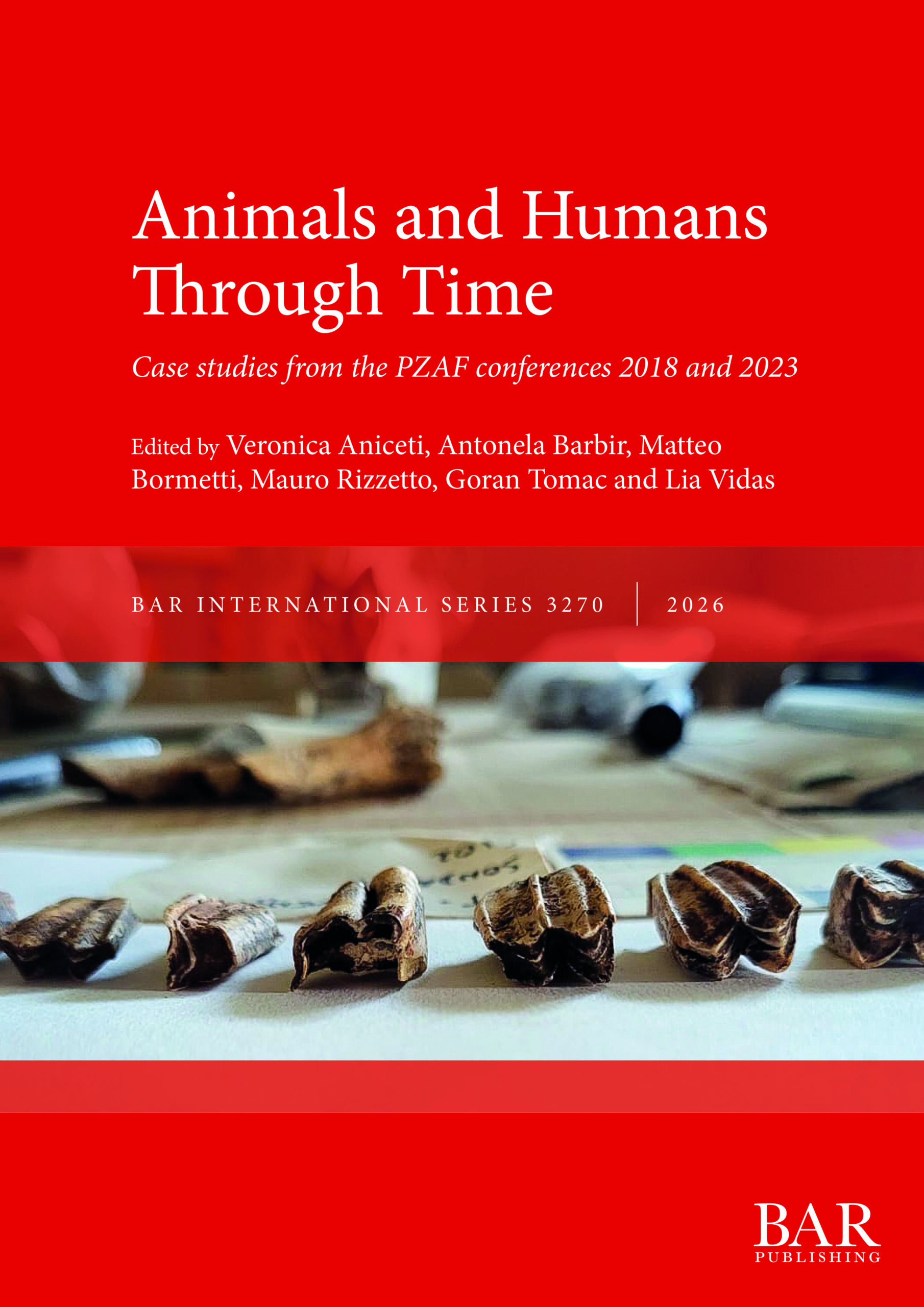
Animals and Humans Through Time
Case studies from the PZAF conferences 2018 and 2023
Edited by Veronica Aniceti, Antonela Barbir, Matteo Bormetti, Mauro Rizzetto, Goran Tomac and Lia Vidas
£43.00 – £55.00
Description
The papers in this volume represent a selection of early career zooarchaeological research originally presented at the 7th and 10th meetings of the Postgraduate ZooArchaeology Forum, held in Palermo in 2018 and in Zagreb in 2023. The decision to combine the papers from both meetings into a single publication offers a geographically much wider display of the state of research in this scientific area, including research from Peru, South Africa, Armenia, Italy, Serbia, and Scotland. The majority of the authors in the volume produced these papers as extensions of their Master’s and PhD theses, and therefore, the publication of their work provides valuable overview of the variety of research topics, scientific methods and new insights permeating the studies of human-animal interactions in the past, and in particular those of interest to early career researchers who provide an insight into the future of the field.
About the Editor
Veronica Aniceti is a zooarchaeologist specialising in the study of human-animal relationships and long-term socio-economic, cultural, and environmental transformations from the late Roman to medieval periods across Europe.
Antonela Barbir is a zooarchaeologist at the Institute of Archaeology in Zagreb, specialising in mammal and mollusc remains to study human–animal relationships in the eastern Adriatic.
Matteo Bormetti is a zooarchaeologist working on the social and economic aspects of human/animal relationship across Europe, the Mediterranean and Arabia.
Mauro Rizzetto is a zooarchaeologist specialising in the prehistoric, Roman and medieval periods of Europe and the Mediterranean studying food production practices and the socio-cultural role of animals in past human communities.
Goran Tomac is a zooarchaeologist working at the University of Zagreb. His research focuses on studying human-animal relationships in prehistoric continental Croatia.
Lia Vidas is a zooarchaeologist working at the Institute for Anthropological Research in Zagreb, specialising in morphological and palaeoproteomic analyses of Pleistocene faunal remains in Croatia.
List of Contributors: Claudia Abatino, Patricia Aleixo, Veronica Aniceti, Alexander Antonites, Antonela Barbir, Helene Benkert, Kinga Bigoraj, Matteo Bormetti, Raffaella Cassan, Jacopo De Grossi Mazzorin, Katarina Dmitrović, Céline Erauw, Mladen Jovičić, Marco Liberato, Elena Maini, Dimitrije Marković, Gianluca Mastrocinque, Thea Messina, Claudia Minniti, Mladen Mladenović, Teodora Mladenović, Erica Platania, Vito Giuseppe Prillo, Mauro Rizzetto, Adriana Sciacovelli, Grazia Sergi, Francesca Sogliani, Goran Tomac, Lia Vidas, Holly Young.
Reviews
‘This volume also stands as a testament to the passion and dedication of a new generation of zooarchaeologists. Each paper offers a unique perspective, enriching our understanding of how these relationships are shaped by cultural, environmental, and temporal factors.’ Dr Lenny Salvagno, University of Sheffield
‘Collectively, the volume broadens the empirical foundation for global zooarchaeology by integrating datasets that are rarely synthesized in publications. Themes emerging across chapters—livestock management diversity, ritual deposition and feasting, specialized craft production (tanning, horn-working), marine resource exploitation, and the interpretive implications of recovery strategies—promise to stimulate new comparative research beyond traditional core regions.’ Dr Roger Alcàntara Fors, Autonomous University of Barcelona
You might also like...
-
Isla Cerritos
Rafael CobosPrint Book £54.00
PDF eBook £42.00 -

Life and Death on the New Zealand Goldfields Frontier
Peter Petchey and Hallie BuckleyPrint Book £61.00
PDF eBook £47.00 -
Fragile Gods
Matthew FittockPrint Book £82.00
PDF eBook £63.00 -
Cerámica de importación y rutas comerciales en época ibérica plena (ss V-III a.n.e.) en la Región de Murcia
Francisco Ramos MartínezPrint Book £32.00
PDF eBook £25.00 -
Interdisciplinary Approaches to Small Objects in the Mediterranean
Agustina Scaro and Eva Amanda CalominoPrint Book £42.00
PDF eBook £32.00

