

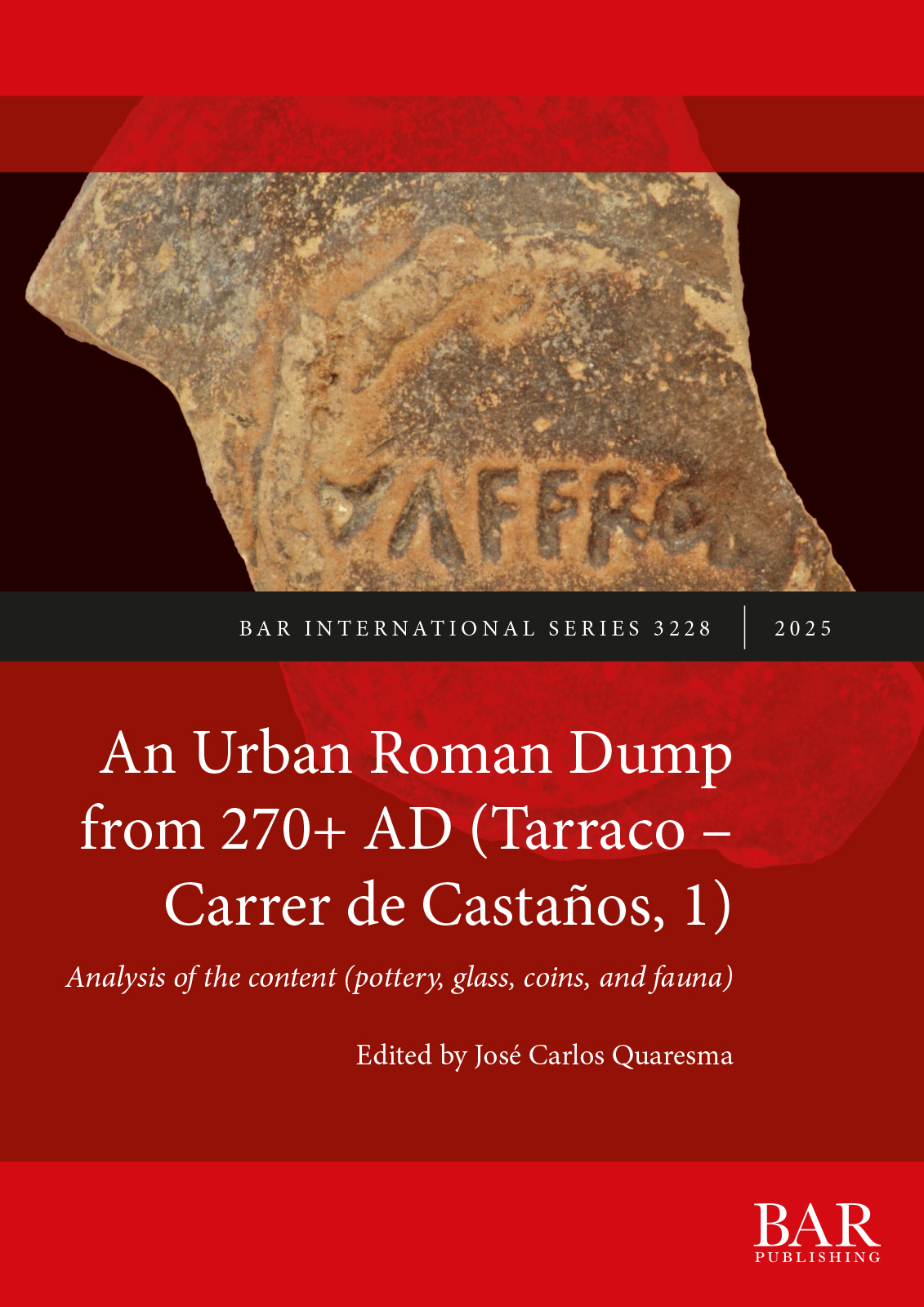
An Urban Roman Dump from 270+ AD (Tarraco – Carrer de Castaños, 1)
Analysis of the content (pottery, glass, coins, and fauna)
Edited by José Carlos Quaresma
$71.40 – $99.00
Description
The second half of the 3rd century AD raises typological questions of enormous interest for understanding processes of economic transition just prior to further changes under the Tetrarchy. Carrer de Castaños, 1 provides an enormous context, consisting of a refuse dump formed from around 270 AD. It includes almost 14,000 sherds of terra sigillata, cooking ware, amphorae, lamps, and unguentaria with 80 different regional/archaeometric origins. It therefore constitutes a reference point for a typo-chronological understanding of ceramics in circulation across the western Mediterranean during the latter parts of the 3rd century. Supported by quantification of types and subtypes, several ceramic morphologies are subjected to fresh chronological discussion. This book also presents and discusses different categories of finds (glass, coarse ware, coins, and fauna) to obtain a complex picture of consumption trends and a more secure idea of the chronology of the refuse dump.
About the Editor
José Carlos Quaresma is a professor at NOVA University Lisbon, working on Roman and Late Antique archaeology, focussing especially on trade and the economy.
List of Contributors: Joan Manuel Coll, Lídia Colominas, Martim Lopes, José Carlos Quaresma, Josep-Anton Remolà Vallverdú, Katie Tardio, Immaculada Teixell Navarro.
Reviews
‘Undoubtedly, the work will become a significant reference volume, not only as a description of a rare context from the late 3rd century AD but especially as a systematization of categories of materials common in this chronology.’ Professor Violeta Moreno Megías, University of Sevilla.
‘The work is important and a significant contribution because of the limited knowledge and stratigraphic contexts for Iberia in general, the Late Roman Period in particular, and for contexts that exemplify the trade relationships between the different blocks of the Roman Empire.’ M. Wade, Associate Professor (Emerita), University of Texas at Austin.
You might also like...
-
The Transition from Lower to Middle Palaeolithic and the Origin of Modern Man
Avraham RonenPrint Book $102.60
PDF eBook $82.60 -
Velebit, a Tumulus Culture Necropolis in the Southern Carpathian Basin (Vojvodina, Serbia)
Aleksandar KapuranPrint Book $39.15 -
The Production and Distribution of Roman Military Equipment
M.C. BishopPrint Book $109.35
PDF eBook $88.20 -
Upper Palaeolithic Osseous Artifacts from Britain and Belgium
Patricia McCombPrint Book $103.95
PDF eBook $82.60 -

The Scandinavian Character of Anglian England in the Pre-Viking Period
John HinesPrint Book $120.15
PDF eBook $96.60

