

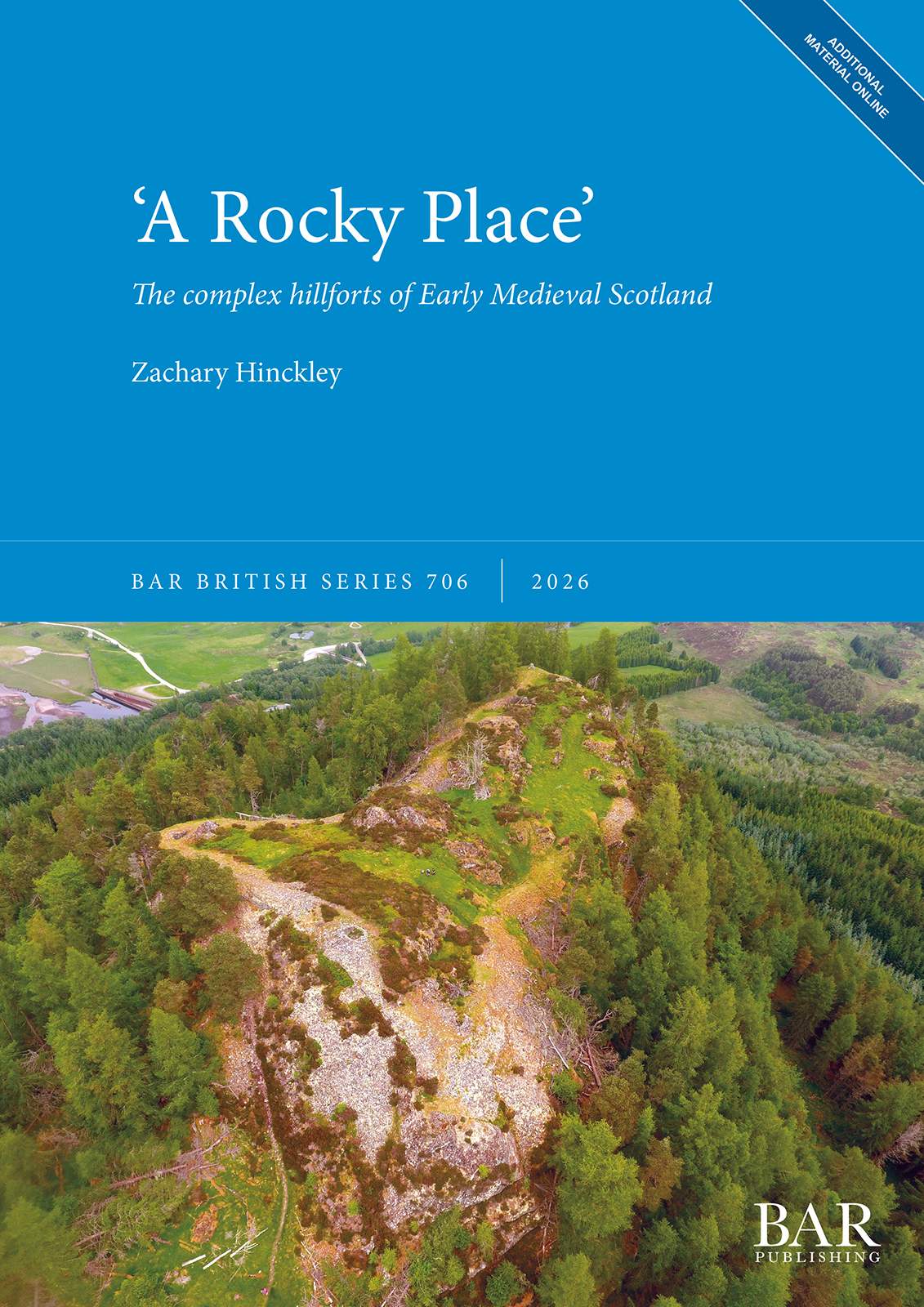
‘A Rocky Place’
The complex hillforts of Early Medieval Scotland
Written by Zachary Hinckley
£34.00 – £44.00
Description
The hillfort is predominately viewed as an Iron Age structure, however (re)occupation and de novo constructions began to appear in Scotland between the 5th and 8th centuries AD. The re-emergence of hillforts coincided with drastic upheaval of societal and cultural changes in Early Medieval Scotland and Europe. Based on R.B.K. Stevenson’s (1949) definition of the ‘nuclear’ fort, this book creates the first comprehensive database of sites that have characteristics of the original definition. Excavations in the 1980s proved that some ‘nuclear’ forts were of Early Medieval date, however, recent excavations suggest that this morphology began sometime in the Middle Iron Age. Few of these sites – just over twenty – have been identified since.
Excavation at six sites in the database took place with radiocarbon dates from each adding to the growing number of radiocarbon dates for these sites. The excavated sites were Craig Rock, Dunmore and Norman’s Law in Fife, Mither Tap of Bennachie and Craig Dorney in Aberdeenshire, and Dunsinane Hill in Perth and Kinross. These excavations, along with drone survey and photogrammetry of other forts, shed light on this enigmatic site type. Despite a lack of radiocarbon dates outside of Pictland, new insights and information suggest that the ‘nuclear’ morphology of hillforts began sometime in the Middle Iron Age and continued through to the Early Medieval period. The author suggests specific attributes that can help distinguish between Iron Age or Early Medieval complex forts.
About the Author
Zachary Hinckley is an archaeologist specialising in Early Medieval Scottish hillforts and landscape, gaining his PhD on the subject in 2024 from the University of Aberdeen.
Reviews
‘An up-to-date synthesis of hillforts within the Early Medieval period has been long overdue. This publication is therefore a welcome, significant, and timely, addition to the consideration of hillforts and our understanding of the role they played in societal change throughout their use.’ Bruce Mann, Aberdeenshire Council Archaeology Service
You might also like...
-
Hazor, Israel
Shulamit GevaPrint Book £49.00
PDF eBook £39.00 -
Lordship and the landscape
John HuntPrint Book £44.00
PDF eBook £34.00 -
The Origins of Hereditary Social Stratification
Malcolm McKayPrint Book £56.00
PDF eBook £44.00 -
Genre et hiérarchisation dans le monde nord-alpin, aux âges du Bronze et du Fer
Caroline TrémeaudPrint Book £72.00
PDF eBook £56.00 -
Pattern and Process in the Material Culture of Anglo-Saxon Non-elite Rural Settlements
Hana LewisPrint Book £52.00
PDF eBook £41.00

