

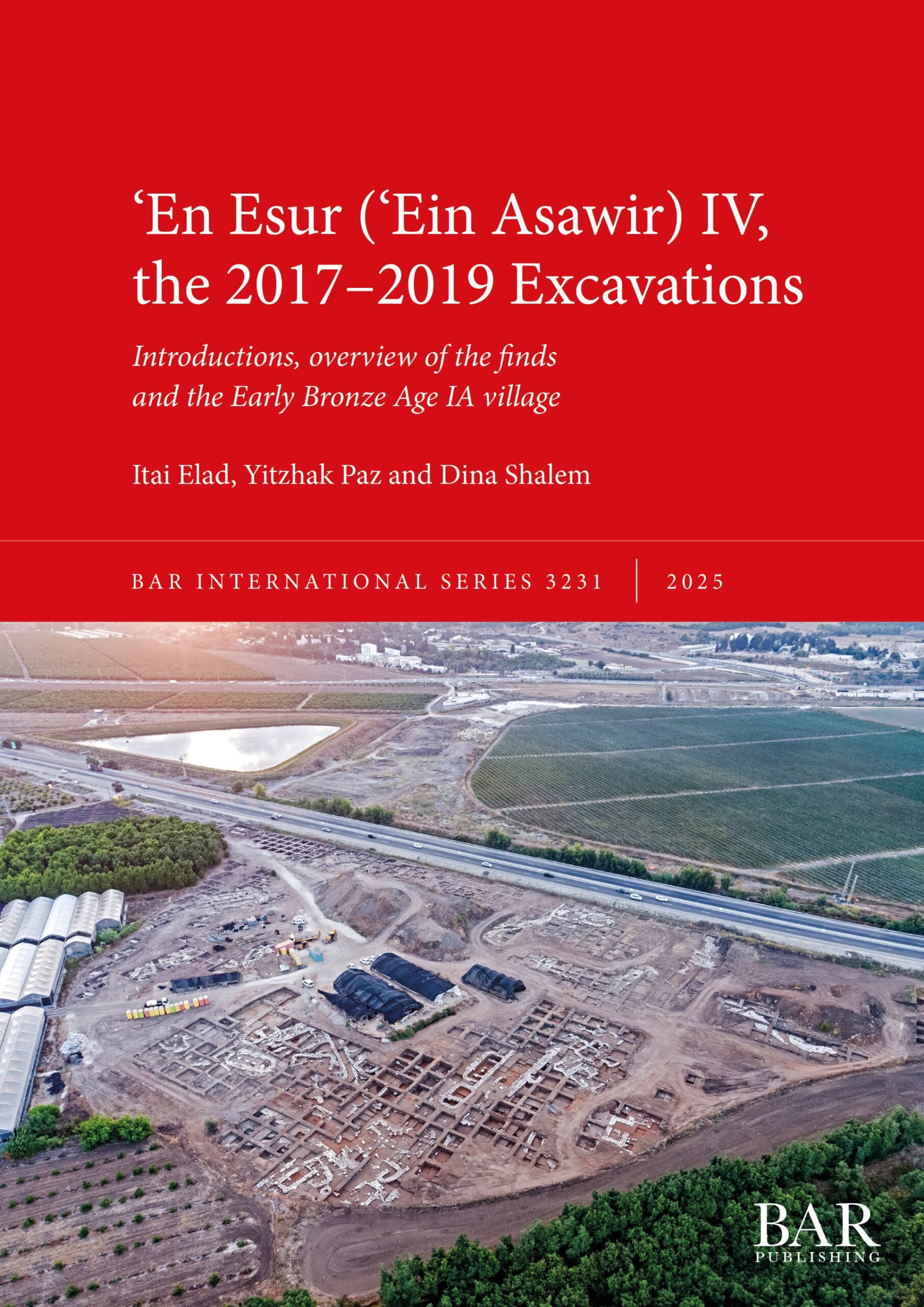
ʻEn Esur (ʻEin Asawir) IV, the 2017–2019 Excavations
Introductions, overview of the finds and the Early Bronze Age IA village
Written by Itai Elad, Yitzhak Paz and Dina Shalem
$99.40 – $138.00
Description
In 2017–2019, large-scale excavation was conducted at the proto-historic site of ʻEn Esur (ʻEin Asawir) in the northern coastal plain of Israel. This excavation resulted in one of the most extensive exposures of any proto-historic site in the Southern Levant, revealing a main occupation sequence spanning the 6th-4th millennia BCE.
This book is the first of several constituting the final report of the 2017–2019 excavation at ʻEn Esur. The book is divided into three parts. The first part offers introductions to the site, its setting and its research history. The second includes a preliminary overview of the main findings, aiming at presenting a cohesive sequence of the occupation at ʻEn Esur. The third part of the book includes the final report of the Early Bronze IA remains.
About the Author
Itai Elad is an archaeologist in the Israel Antiquities Authority, currently pursuing a doctorate at Ben-Gurion University. His PhD research focuses on urbanization in the Southern Levant during the Early Bronze Age IB.
Yitzhak Paz is a senior researcher in the Israel Antiquities Authority with expertise in proto-historic periods and various aspects of material culture in the Ancient Near East during the 4th–3rd millennia BC.
Dina Shalem is a senior researcher in the Israel Antiquities Authority whose main research focus includes the 6th–5th millennia BCE, ancient art, burial and ritual customs.
List of Contributors: Elisabeta Boaretto, Lena Brailovsky-Rokser, Avi Buzaglo, Itai Elad, Shatil Emmanuilov, Suembikya Frumin, Gil Haklay, Yoel Melamed, Yitzhak Paz, Miriam Pines, Dina Shalem, Anastasia Shapiro, Ehud Weiss.
Reviews
‘The EBIA, which follows on the heels of the Chalcolithic period when social inequality became institutionalized across the southern Levant, is an enigmatic period because the complexities that arose in the Chalcolithic (craft specialization, two-tier settlement hierarchies, and more) disappear in the EBIA. Why? This book and the large ʻEn Esur database can help answer these issues, especially since an increase in social complexity appears in the following EBIB period.’ Professor Thomas E. Levy, University of California, San Diego
You might also like...
-
Un Poblado de la Edad del Bronce en El Castillo
R. J. HarrisonPrint Book $54.00
PDF eBook $43.40 -
La Edad del Hierro de los Ártabros
Samuel Nión-ÁlvarezPrint Book $121.50
PDF eBook $88.20 -
Megalithism in the Llobregat river basin (Catalonia) 3200-1500 cal BCE
Elisabet López GarrigaPrint Book $85.50
PDF eBook $61.60 -
Zooarchaeology in the Middle Nile Valley
Ali Tigani ElMahiPrint Book $52.65
PDF eBook $43.40 -
Vaghi, pendenti e sigilli dell’età del Bronzo in Italia meridionale
Ilaria MataresePrint Book $115.50
PDF eBook $82.60

