

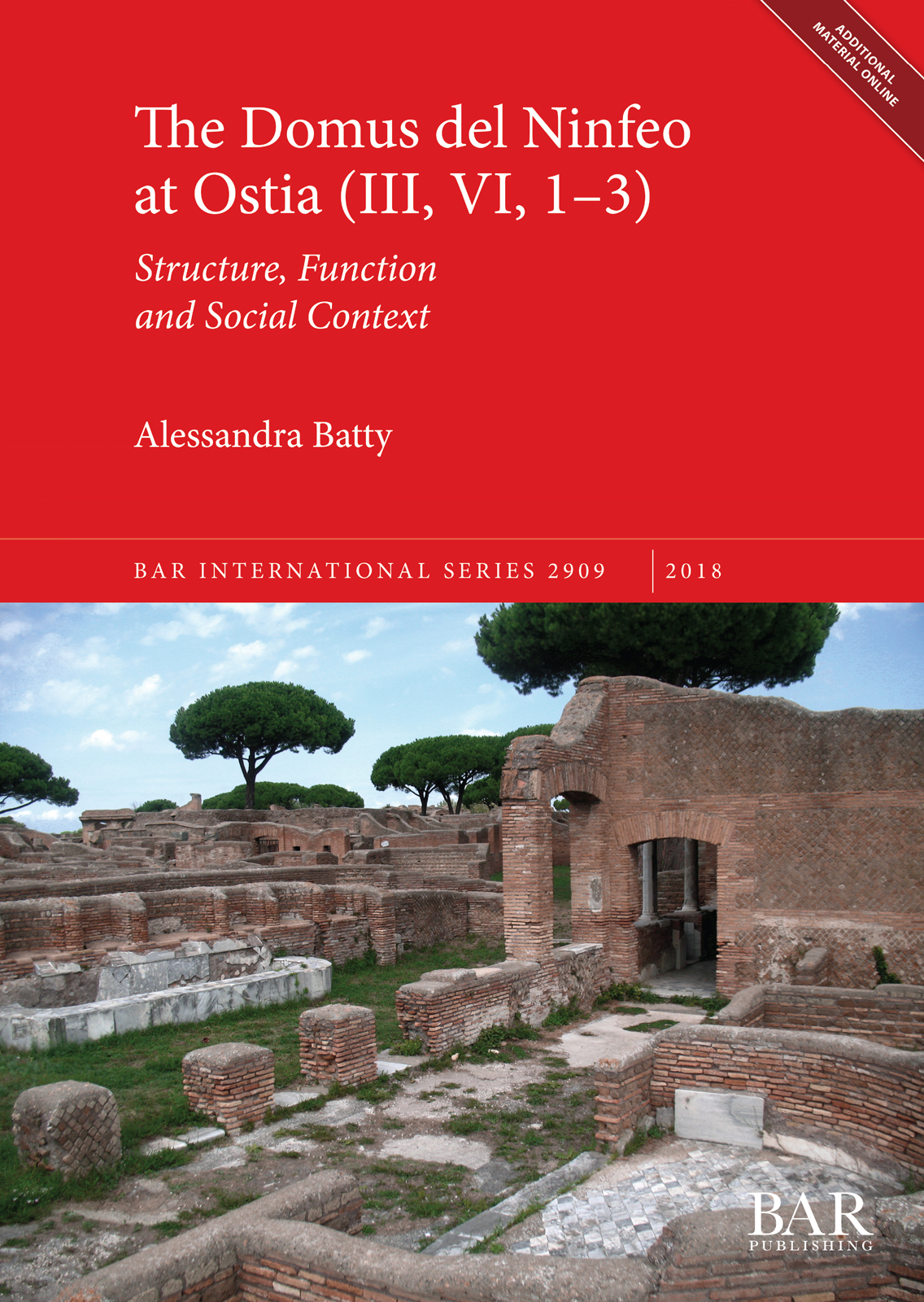
The Domus del Ninfeo at Ostia (III, VI, 1-3)
Structure, Function and Social Context
Written by Alessandra Batty
£62.00 – £87.00
Description
This book is the first in-depth analysis of one of the most remarkable monuments of Ostia, the ancient port town of Rome: The Domus del Ninfeo (III, VI, 1-3). Originally built as a multi-storey complex during the reign of Hadrian, in Late Antiquity it was converted into a ground-floor mansion to serve the dominus and his extended family. During this phase the building was enriched with marble floors and the elegant nymphaeum that gives it its current name. This study aims to present a comprehensive picture of the Domus, analysing not only the many structural changes but also its topographical setting, historical context and social inferences. The text also features the archaeological drawings that were made during the study and the results of a clearance in an area of the house previously neglected; the latter has provided invaluable evidence for interesting structural modifications that were previously completely unknown.
About the Author
Alessandra Batty holds a first degree and a postgraduate degree in Archaeology from the Università ‘La Sapienza’ (Rome) and an MA in Archaeology and PhD in the History of Art from the University of Manchester. Her main research interests are the history of archaeological studies and the structural analysis of monuments (especially at Ostia).Reviews
‘This is original, in fact, pioneering work. … [Batty’s] handling of the data is exemplary. … A scholar would be hard put to find such a well-reasoned and comprehensive account of Late Antique Ostia. It is so rich!’ Prof. John R. Clarke, University of Texas at Austin ‘This is a very useful volume. Yes, it is single-structure oriented but it offers a lot in terms of understanding how the city of Ostia worked, grew and looked, and it lets readers learn about the rather patchy way that houses have been explored and recorded in the past in Ostia’s extensive archaeological history. … The many who study Pompeii and Ostia and Roman urbanism generally will find much of interest in here.’ Prof. Neil Christie, University of LeicesterYou might also like...
-
Patrones de asentamiento en la Bética romana
Un estudio sobre la romanización desde el análisis arqueológico espacialWritten by Maria del Carmen Moreno EscobarPrint Book £79.00
PDF eBook -
Investigating Consumption: The Archaeology of Social Practice
Papers in honour of Penelope Allison on the occasion of her retirementEdited by Daniël P. van Helden and Victoria SzafaraPrint Book £55.00
PDF eBook £43.00 -
The Last Horizons of Roman Gaul: Communication, Coin Circulation, and the Limits of the Second Burgundian Kingdom
A prosopographical, numismatic, and ceramic synthesis (ca. 395-550 CE)Written by Ryan H. WilkinsonPrint Book £37.00
PDF eBook £26.00 -

Unit Sizes in the Late Roman Army
Written by Terence CoelloPrint Book £25.00
PDF eBook £18.00 -
Grabfunde als Spiegel der Bildung
Zur Literalität der Frauen in den westlichen Provinzen des römischen ReichesWritten by Josy LuginbühlPrint Book £89.00
PDF eBook

