

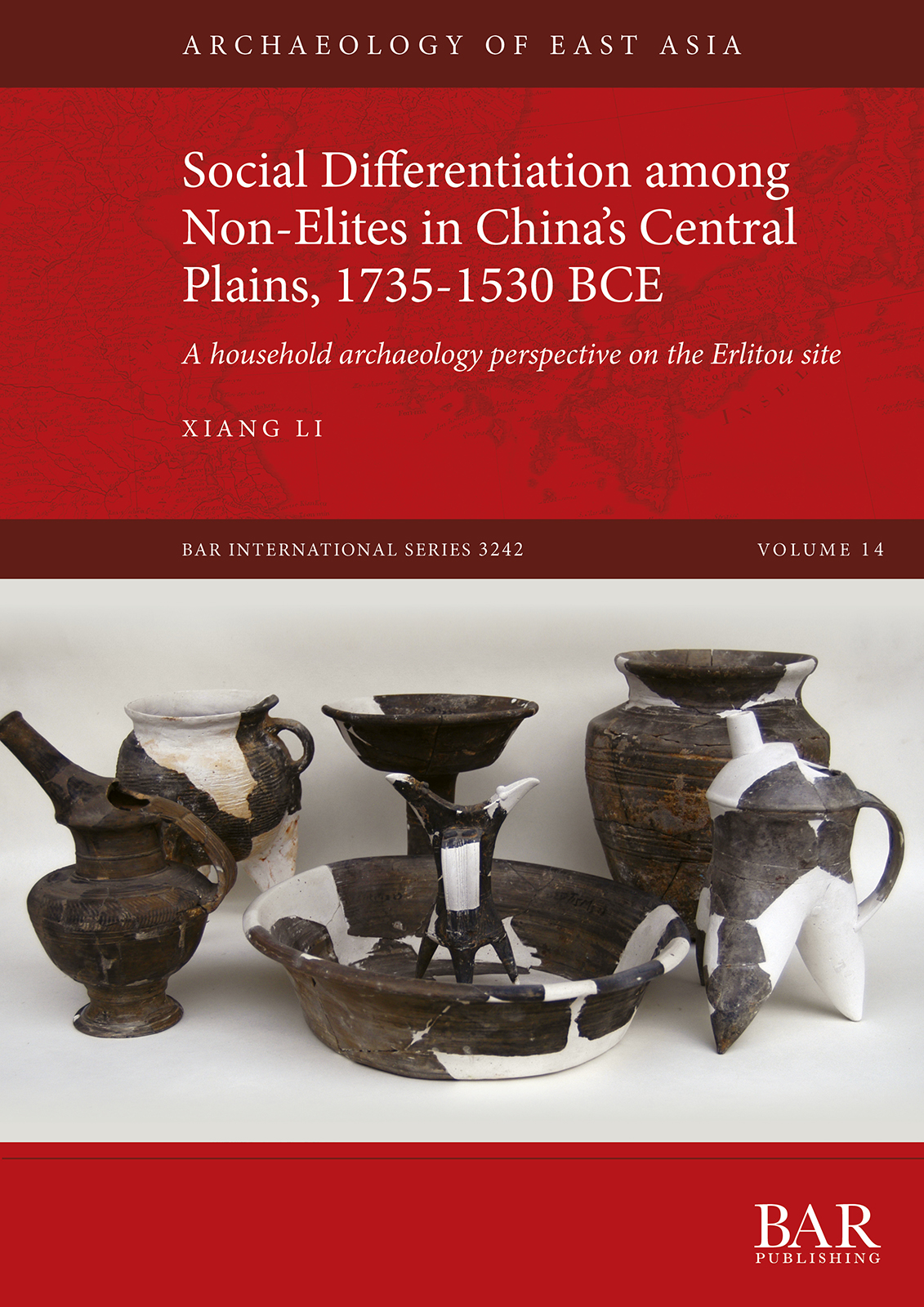
Social Differentiation among Non-Elites in China’s Central Plains, 1735-1530 BCE
A household archaeology perspective on the Erlitou site
Written by Xiang Li
€27.60 – €36.00
Description
Since its discovery in 1959, research on the Erlitou site has revealed China’s first territorial state, dating from 1753 to 1530 BCE according to the latest C-14 dating. The capital’s large rammed-earth structures and enclosed inner city suggest strong royal economic and labor-organizing capacities. The southern workshop enclosure housed elite-sponsored crafts like bronze casting and turquoise working. The city’s settlement system relied on resource acquisition and tribute. However, existing studies lack focus on internal social complexity, especially bottom-up social differentiation. This book challenges the notion of a homogeneous non-elite class, being the first to study Erlitou society via household archaeology, focusing on non-elite households in the capital. Using multi-dimensional scaling, it uncovers the majority, overshadowed by elites and splendid artifacts, expanding household archaeology’s application in China’s Bronze Age.
About the Author
Xiang Li is assistant research fellow at the National Centre for Archaeology in China and is interested in social complexity and state formation.
Reviews
‘Rather than focusing on the social elites and related glamorous material representations, the author pays more attention to the majority of the Bronze Age society, which always has low visibility and thus is ignored by previous researchers. The publication of the current work will definitely change this imbalanced situation.’ Chenghao Wen (Research Associate, Institute of Archaeology, Chinese Academy of Social Sciences)
You might also like...
-
Measuring Complexity in Early Bronze Age Greece
Melanie A. FilliosPrint Book €73.20
PDF eBook €56.40 -
State-Periphery Relations and Sociopolitical Development in Igbominaland, North-Central Yoruba, Nigeria
Aribidesi Adisa UsmanPrint Book €61.20
PDF eBook €48.00 -
La Casa Arqueológica
Juan Garcia Targa and Geiser Gerardo Martín MedinaPrint Book €78.00
PDF eBook €61.20 -
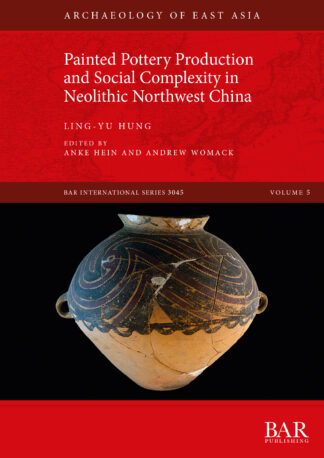
Painted Pottery Production and Social Complexity in Neolithic Northwest China
Ling-yu Hung†Print Book €60.00
PDF eBook €46.80 -
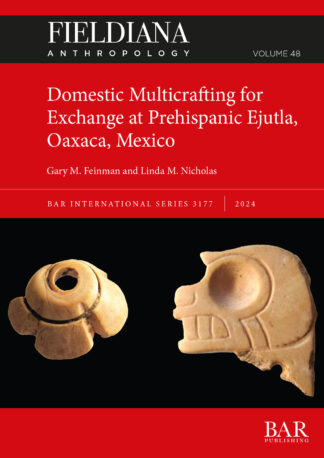
Domestic Multicrafting for Exchange at Prehispanic Ejutla, Oaxaca, Mexico
Gary M. Feinman and Linda M. NicholasPrint Book €54.00
PDF eBook

