

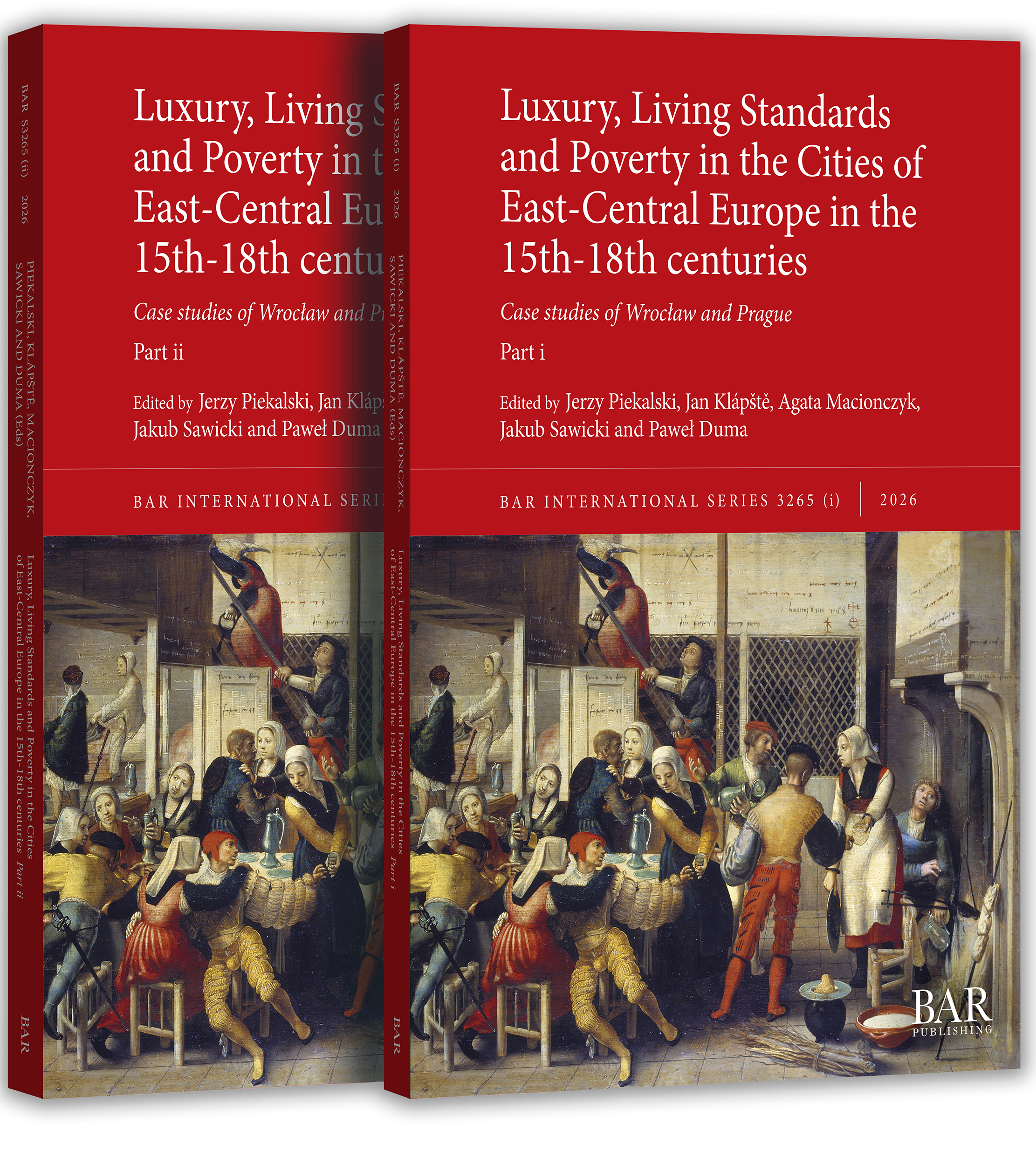
Luxury, Living Standards and Poverty in the Cities of East-Central Europe in the 15th-18th centuries, Parts i and ii
Case studies of Wrocław and Prague
Edited by Jerzy Piekalski, Jan Klápště, Agata Macionczyk, Jakub Sawicki and Paweł Duma
£1.00 – £267.00
Description
This is an open access title available under the terms of a CC BY-NC 4.0 License. It is free to read, download and share on the BAR Digital platform.
This study aims to reconstruct the quality of life and urban lifestyles in Central-East Europe prior to industrialisation. Employing historical archaeology – an interdisciplinary approach integrating humanities and natural sciences – the research focuses on two key cities: Wrocław, Silesia’s historic capital, and Prague, Bohemia’s royal metropolis. Culturally linked during this period, both cities endured modern-era political upheavals, devastating wars, economic shifts, and evolving artistic and architectural trends. This methodological framework facilitates a comprehensive analysis of their natural environments, socio-topographic zones, and urban development, including sanitation infrastructure. It also examines material culture disparities shaped by social status, societal roles, and individual preferences. Furthermore, the research provides insight into the intellectual life of city dwellers, their religious consciousness, complex symbolism, and the educational system developed since the Middle Ages, including Prague’s university – the oldest in Central Europe.
This book is part of a two-part set: ISBN 9781407364575 (Part i); ISBN 9781407364582 (Part ii); ISBN 9781407362977 (set of both parts).
About the Editor
Jerzy Piekalski is a professor of medieval and post-medieval archaeology at the University of Wrocław, researching towns, castles and cultural landscapes.
Jan Klapste is a professor of medieval archaeology at Charles University in Prague, researching Czech lands and medieval Europe.
Agata Macionczyk is an archaeologist specialising in plant symbolism in funerary rites. She is currently working in the Late Medieval Department at the Wrocław Archaeological Museum.
Jakub Sawicki is a researcher in medieval and modern material culture at the Czech Academy of Sciences. He is MERC Vice-Chair and co-founder of the European Medieval Finds Network.
Paweł Duma is a historical archaeologist, and assistant professor at the University of Wrocław focusing on lifestyle and material culture.
List of Contributors: Helena Březinová, Jana Bureš Víchová, Aleksander Chrószcz, Ivana Čornejová, Tomasz Cymbalak, Paweł Duma, Jan Hasil, Pavla Hasilová, Marta Kanarkiewicz,
Jan Klápště, Magdalena Konczewska, Jerzy Kunicki-Goldfinger, Sylwia Lech, Maria Legut-Pintal, Agata Macionczyk, Lech Marek, Beata Miazga, Magdalena Mielnik, Martin Musilek, Elżbieta Myśkow, Jerzy Piekalski, Jaroslav Podliska, Grzegorz Podruczny, Dominik Poradowski, Vladislav Razím, Štěpán Rückl, Michael Rykl, Jakub Sawicki, Jakub Szajt, Krzysztof Wachowski, Anna Žďárská, Jaromír Žegklitz.
Reviews
‘This will be a book of fundamental importance for historical archaeology and urban archaeology in Central and Central-Eastern Europe.’ Dr Maciej Trzeciecki, Polish Academy of Sciences
‘The combination of all available source data provides a foundation for the characterization of Prague and Wrocław, viewed not only through the lens of the townhouse and plot, consumption, and craftsmanship, but also fortifications and military equipment. This book will likely become not only an important summary of the current state of research, but also a starting point for further analyses.’ Associate Professor Marcin Majewski, University of Szczecin
‘There are several treatises on aspects of urban material culture and its sociological interpretation, but this volume covers them all in one edition. It also compares two cities, which is unique in its kind. It is very good to see archaeological comparison on this scale.’ Dr Dirk Rieger, Head of Archaeology and Monuments Preservation, Hanseatic City of Lübeck
You might also like...
-
Investigating Consumption: The Archaeology of Social Practice
Papers in honour of Penelope Allison on the occasion of her retirementEdited by Daniël P. van Helden and Victoria SzafaraPrint Book £55.00
PDF eBook £43.00 -
The Contemporary Archaeology of Inequality
Material culture and social changeEdited by Tuuli Matila, Marika Hyttinen and Oula SeitsonenPrint Book £34.00
PDF eBook £26.00 -
Over Land and Sea
The long-distance trade, distribution and consumption of ancient Greek potteryEdited by Alejandro Garés-Molero,Diana Rodríguez-Pérez,Agustín A. Diez-CastilloPrint Book £49.00
PDF eBook £39.00

