

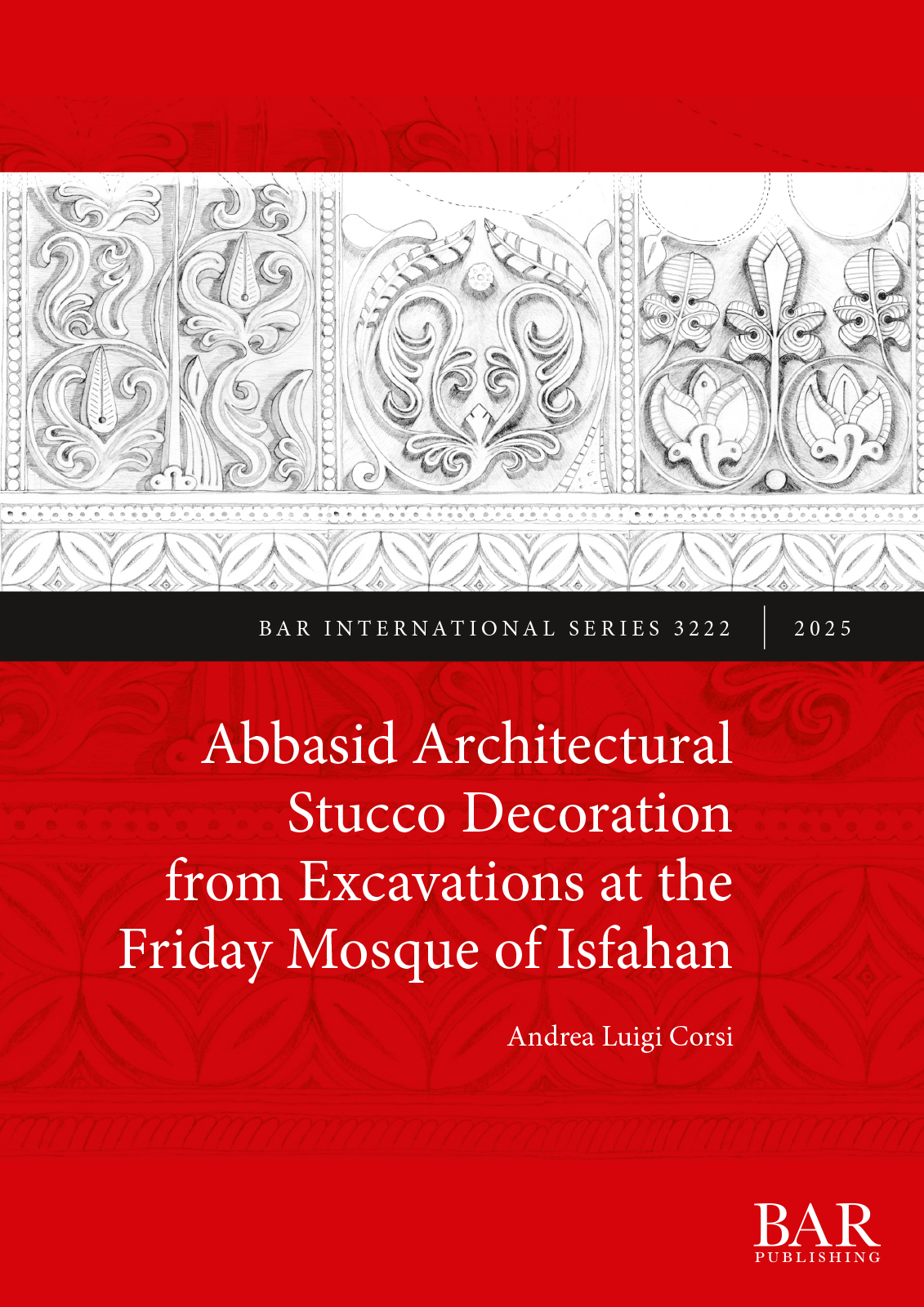
Abbasid Architectural Stucco Decoration from Excavations at the Friday Mosque of Isfahan
Written by Andrea Luigi Corsi
£28.00 – £40.00
Description
The book addresses a complete corpus of Islamic stucco, analysed within its archaeological stratigraphic context. The finds mostly pertain to the two Abbasid phases of the Friday Mosque of Isfahan (767 and 840–41 CE), excavated in the 1970s by the Italian Archaeological Mission in Iran directed by Umberto Scerrato. The corpus includes some panels in situ (from the miḥrāb and qiblī wall) and around 500 diagnostic fragments. The stratigraphic data and the analytical study of the techniques and compositions of the stuccoes made it possible to identify different production phases pertaining to the two Abbasid phases of the mosque. The book proposes a reconstruction of the stucco decoration of the qiblī wall of the first mosque (767 CE), a kind of architectonic backdrop divided into at least two horizontal registers, which constitutes one of the earliest visual renderings of the decorative programme of a mosque.
About the Author
Andrea Luigi Corsi is Adjunct Professor of Islamic Archaeology at Sapienza University of Rome and Research Associate at the Department of History of Art of the University of York.
Reviews
‘This is a much-needed addition to the literature on the earliest phases of decoration of this most significant monument and will be an important publication.’ Dr Richard McClary, University of York
‘The data presented in the manuscript is both new and significant, offering a valuable contribution to the study of early Islamic archaeology and architecture. By integrating material evidence with architectural interpretation, this book addresses a significant gap in the literature and will serve as a key reference for future research on early Islamic stucco decoration.’ Simone Struth, Museum of Islamic Art, Doha
You might also like...
-
Near Eastern Helmets of the Iron Age
Written by Tamás DezsöPrint Book £76.00
PDF eBook £54.00 -
El Geili
The History of a Middle Nile Environment, 7000 B.C.-A.D. 1500Edited by I. Caneva with contributions by Patrizia Baracchini, Alfredo Coppa, Vincenzo Francaviglia, Ezio Fulcheri, Achilles Gautier, Alessandro Lentini, Bruno Marcolongo, Alberto M. Palmieri, Maria Reddavid and Guiseppe ScalaPrint Book £95.00
PDF eBook £67.00 -
Armies and Frontiers in Roman and Byzantine Anatolia
Proceedings of a colloquium held at University College, Swansea, in April 1981Edited by Stephen MitchellPrint Book £87.00
PDF eBook £62.00 -
Zabid Project Pottery Manual 1995
Pre-Islamic and Islamic Ceramics from the Zabid area, North YemenWritten by Christopher Ciuk and Edward KeallPrint Book £33.00
PDF eBook £23.00 -
Mayotte au temps des Califes (IXe – XIIe siècle)
Archéologie de l’Océan Indien à Ironi Be, Commune de DembeniEdited by Stéphane PradinesPrint Book £87.00
PDF eBook £62.00

